The biggest choice here isn’t between three 128GB phones. It’s between a 5G Motorola with 8GB of RAM and two 4G Samsungs with AMOLED screens. The Galaxy A17 adds optical image stabilization to its main camera; the Galaxy A16 keeps much of the Samsung experience but makes more sense when it costs meaningfully less.
There’s one important wrinkle for U.S. buyers: the three product listings supplied for this comparison are on Amazon Australia. An unlocked phone sold for another market isn’t automatically a good match for a U.S. carrier. Check the exact model and its IMEI with your carrier before ordering, not just the phone’s name.
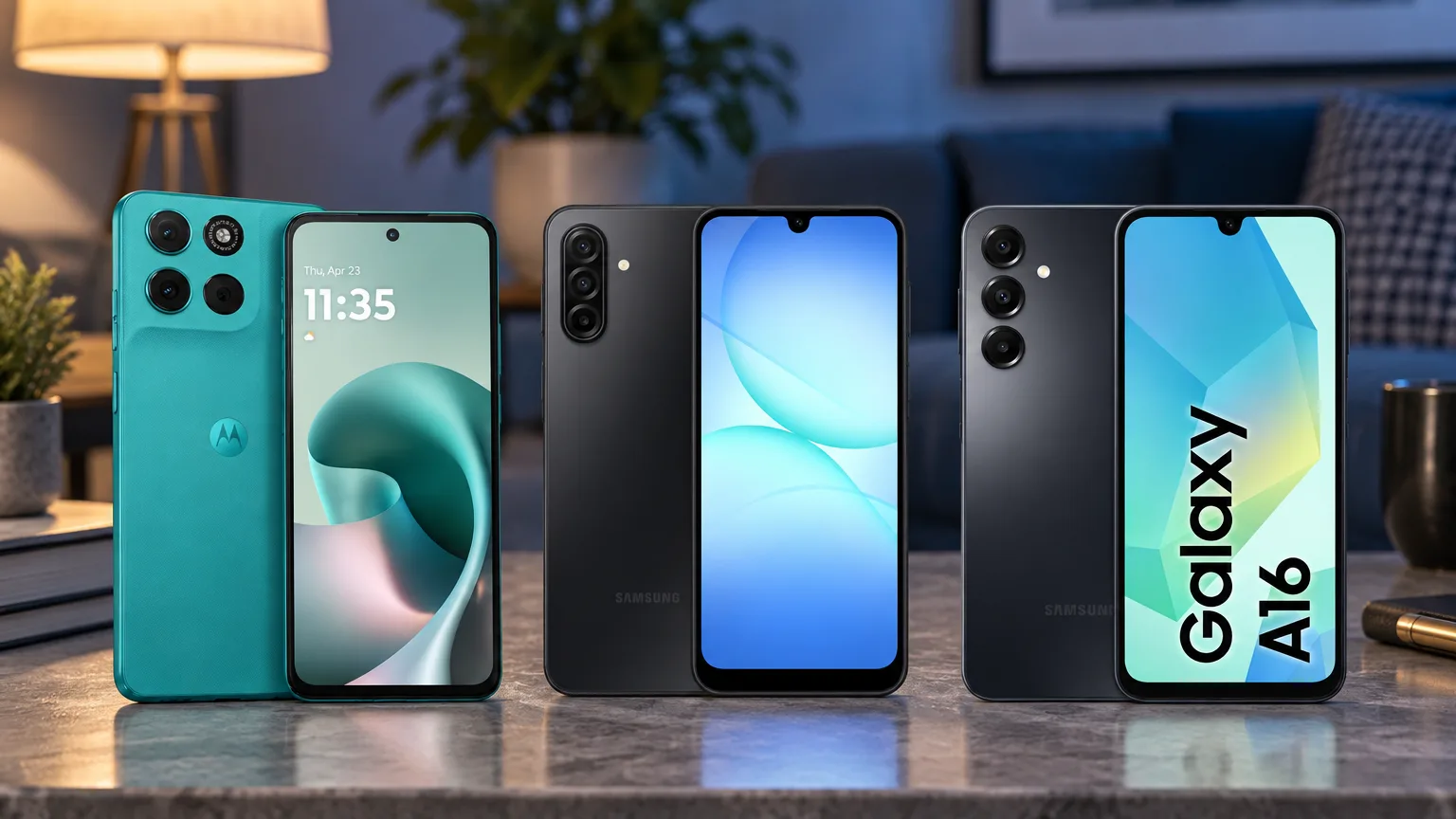
The quick answer
- Choose the Motorola G57 if you want 5G, 8GB of RAM, a faster-refreshing LCD, and a headphone jack—and have confirmed U.S. network compatibility.
- Choose the Galaxy A17 4G if an AMOLED screen, a stabilized main camera, and Samsung’s long update promise matter most.
- Choose the Galaxy A16 4G if you want an AMOLED Samsung and don’t need the A17’s stabilized camera.
The specific listings are the Motorola G57 8GB 128GB, Samsung Galaxy A17, 4G, 128GB, and Samsung Galaxy A16 4G 128GB. Check the selected RAM, storage, model number, and seller terms on each listing; specifications and support can differ by region.
How the three compare
| Feature | Motorola G57 8GB 128GB | Samsung Galaxy A17, 4G, 128GB | Samsung Galaxy A16 4G 128GB |
|---|---|---|---|
| Display | 6.72-inch FHD+ LCD, 120Hz | 6.7-inch FHD+ Super AMOLED, 90Hz | 6.7-inch FHD+ Super AMOLED, 90Hz |
| Processor | Snapdragon 6s Gen 4 | Helio G99 | Helio G99 |
| RAM and storage | 8GB and 128GB | 4GB and 128GB | 4GB and 128GB |
| Cellular connectivity | 5G | 4G LTE | 4G LTE |
| Rear cameras | 50MP main and 8MP ultrawide; no optical stabilization | 50MP main with optical stabilization, 5MP ultrawide, 2MP macro | 50MP main without optical stabilization, 5MP ultrawide, 2MP macro |
| Battery capacity | 5,200mAh | 5,000mAh | 5,000mAh |
| microSD expansion | No | Up to 2TB; shared with a SIM slot | Up to 1.5TB; shared with a SIM slot |
| Stated software support | — for the specific 8GB listing | Up to six OS upgrades and six years of security support | Up to six OS upgrades and six years of security support |
- View on Amazon
Motorola G57 8GB 128GB
- View on Amazon
Samsung Galaxy A17, 4G, 128GB
- View on Amazon
Samsung Galaxy A16 4G 128GB
A dash does not mean the G57 receives no updates.
Motorola G57 8GB 128GB: the 5G and multitasking choice
The G57 has the clearest hardware advantage for someone who keeps several apps open: this listing pairs 8GB of RAM with 128GB of storage, while the specified Samsung versions have 4GB of RAM. More RAM gives apps more room to stay open in the background. It does not, by itself, prove that the Motorola will run every game or demanding task faster.
Its 120Hz LCD is also the choice for buyers who put a premium on smooth scrolling. The trade-off is screen technology: the Samsungs use Super AMOLED panels, while the G57 uses LCD. If rich contrast matters more to you than the difference between 90Hz and 120Hz, look at the Samsungs instead. A review of the G57’s display and hardware also confirms a 3.5mm headphone jack and no microSD slot. The jack is genuinely useful if you still use wired headphones; the fixed storage is a reason to think carefully about how many videos and offline downloads you keep.
The standard G57—not the G57 Power—has a 5,200mAh battery and 30W charging. Don’t confuse it with the Power model’s larger battery when reading listings or reviews. Motorola also rates the standard phone IP64 for dust and splash resistance; that is not a promise that it will survive being submerged.
There’s a software-support qualification worth taking seriously. An Australian reviewer reported no promised major Android upgrades for the G57 version reviewed, but that review describes a 4GB regional configuration, not the 8GB listing here. It would be wrong to assume the same policy applies to every G57. If you expect to keep this phone for years, ask the seller or Motorola to confirm the exact model’s update commitment before choosing it over either Samsung.
Samsung Galaxy A17 4G 128GB: the camera-first Samsung
The A17 is the strongest fit for someone who wants the Samsung display and takes a lot of photos with the main camera. Its key upgrade over the A16 is optical image stabilization, or OIS: the main camera can compensate for some hand movement. That makes the A17 the more sensible choice for handheld shots in dim light, though it doesn’t guarantee sharp photos of moving people. The two Samsungs’ ultrawide and macro cameras have modest resolutions, so the main camera should drive this decision.
The A17 also has a slimmer, lighter body than the A16: Samsung lists it at 7.5mm and 190g, against 7.9mm and 200g for the A16. That’s a small difference on paper but a reasonable tie-breaker if you handle both phones in a store. Samsung promises up to six OS upgrades and six years of security support for the A17.
Don’t buy it expecting a big speed jump over the A16. Both 4G models use the Helio G99, and Notebookcheck’s A17 4G review found it suited to everyday tasks rather than demanding apps. Its tested battery life was also unexceptional. The A17 is an upgrade for its stabilized camera and lighter build, not a transformation of Samsung’s entry-level performance.
Samsung Galaxy A16 4G 128GB: the value choice
The A16 remains appealing because it keeps the feature many people notice every time they unlock their phone: a large Super AMOLED screen. Samsung’s A16 series announcement confirms a 90Hz display for the LTE model. You also get the same stated six-generation OS upgrade policy as the A17, although the A16 started on an older Android version, so don’t treat their remaining support periods as identical. Samsung’s A16 4G product page sets out its update promise and IP54 splash-resistance rating.
Its limitations are straightforward. The main camera lacks OIS, it has 4GB of RAM in the specified configuration, and it is LTE-only. A review of the A16 4G liked its display and everyday value but did not present it as a high-performance phone. Buy it for calls, messaging, video, browsing, and ordinary photos—not because its three rear lenses promise advanced photography.
Price is the deciding factor between the two Samsungs. If the A16 is only slightly cheaper, the A17’s OIS and lighter design are worth considering. If the gap is substantial and you rarely take photos in difficult light, the A16 gives up little that will matter in routine use. Seller prices vary, so compare the total delivered cost rather than a fleeting deal badge.
Choose by what you’ll notice—and verify before paying
For streaming and reading, start with the two Samsungs’ AMOLED screens; pick the A16 for savings or the A17 for its camera upgrade. For frequent app switching, wired audio, and access to 5G where supported, the 8GB G57 is the more interesting choice. For handheld photos, the A17’s OIS is the most meaningful distinction between the Samsung models.
For a U.S. buyer, though, network compatibility comes before all of those preferences. The Samsung specification pages linked above describe regional 4G models, and a phone being labeled “unlocked” does not establish that every U.S. carrier will activate it. T-Mobile recommends checking the device’s IMEI, while Verizon provides its own IMEI compatibility check. Confirm the exact unit with your carrier and check its U.S. warranty terms before ordering an Australian-market listing. If the seller cannot provide the information needed to do that, the safest choice is to wait—not to guess which of the three phones will work.