A movie rated PG-13 may have a few minutes of frightening images, two hours of intense action, or a difficult subject handled mostly through dialogue. The letters give parents a starting point, but they can’t tell the whole story. The short phrase beside them—“for intense sequences of violence,” for example—often does more useful work.
In the United States, movie ratings describe the level and type of content in a film. They don’t grade its storytelling, recommend an ideal viewing age for every child, or settle what a particular family should watch. Understanding the difference between a rating and its content descriptor makes the system much easier to use.
What the five U.S. movie ratings mean
The Motion Picture Association’s Classification and Rating Administration, or CARA, assigns five ratings to films submitted to its system. Only two restrict admission at participating theaters.
| Rating | Meaning | What it tells a parent |
|---|---|---|
| G — General Audiences | All ages admitted. | The board found nothing it expects would offend parents of young viewers. G does not mean the film was made for children. |
| PG — Parental Guidance Suggested | Some material may not be suitable for children. | Check what prompted the rating, especially for a younger child. |
| PG-13 — Parents Strongly Cautioned | Some material may be inappropriate for children under 13. | This is a stronger advisory, not a rule barring children under 13 from attending. |
| R — Restricted | Viewers under 17 require an accompanying parent or adult guardian. | Expect adult material and check the descriptor before bringing a teen. |
| NC-17 — No One 17 and Under Admitted | Viewers must be 18 or older. | Accompaniment by an adult does not change the age restriction. |
The numbers cause understandable confusion. PG-13 isn’t a claim that every 13-year-old is ready for the movie, just as R isn’t a recommendation for everyone who has turned 17. The categories reflect broad judgments about content; children’s interests and sensitivities don’t change on their birthdays.
An NC-17 rating also shouldn’t be mistaken for a judgment that a film is pornographic or worthless. It means the board considers its content inappropriate for viewers 17 and under. At the other end of the scale, a G rating is not a stamp of artistic merit—or a promise that a very young child will enjoy sitting through the film.
Who assigns a rating, and what do they consider?
CARA is an industry-run system, not a federal government ratings board. Its raters are parents who watch a submitted film in full, vote on a rating, and discuss the decision and its descriptor. They consider the film as a whole, including violence, language, sex, nudity, drug use, smoking, and themes that may concern parents. Filmmakers can revise a film and submit it again or challenge a rating through an appeal process. The ratings are voluntary, though Motion Picture Association members agree to submit their theatrically released films.
Context matters. A threat in a comic fantasy adventure may land differently from the same threat in a realistic drama. Raters weigh how material is shown, not merely whether a particular subject appears. That doesn’t make every decision predictable: the system asks a group of parents to judge what most American parents would want to know, not to apply a fixed count of fights, swear words, or kisses.
The U.S. system began in 1968 as an alternative to the earlier Production Code. PG-13 was added in 1984 to give families a category between PG and R. Its arrival illustrates why the middle ratings need attention: the widest range of family decisions tends to sit between “everyone can attend” and “children need an adult.”
Read the reason after the letters
For films rated PG, PG-13, R, or NC-17, the rating is accompanied by a descriptor: a brief explanation of content that contributed to the decision. G is the exception. Descriptors are tailored to the individual film, rather than drawn from a small set of fixed labels.
The MPA’s guide to descriptors shows why a phrase such as “violence” benefits from its surrounding words:
- “Action” can point to fast-paced peril or combat without the same emphasis on realistic injury as “bloody violence.”
- “Brief” signals that material is limited, while “throughout” signals that it recurs. “Strong” speaks to intensity, not necessarily duration.
- “Language” flags profanity or other concerning speech; “strong language” calls for closer attention if particular words matter in your home.
- “Suggestive references” generally concerns dialogue or implication. It does not communicate the same thing as a descriptor for sexual content or nudity.
- “Drug references” and “drug use” are different clues: talking about drugs is not the same as showing someone taking them.
- “Thematic elements” can cover subjects such as grief, illness, divorce, or bullying. It may tell you little about which subject appears, so it’s a reason to look further when a child has a particular sensitivity.
Consider two hypothetical PG-13 descriptions: “for intense action and peril” and “for mature thematic material and brief strong language.” The same age advisory points to quite different viewing experiences. A child comfortable with fantasy danger might find a story about family loss harder to watch; another might react in the opposite way.
Descriptors are snapshots, not scene-by-scene inventories. They won’t reliably tell you when something happens, how long an upsetting scene lasts, or whether it involves the kind of image that particularly troubles your child. They are most useful as prompts for the next question: What, specifically, would I want to know before we watch?
A movie can display more than one kind of rating
The familiar G-through-NC-17 scale is the U.S. film system. It isn’t interchangeable with television ratings. The TV Parental Guidelines use labels such as TV-Y7, TV-PG, TV-14, and TV-MA. Their letter descriptors have defined meanings: D for suggestive dialogue, L for language, S for sexual situations, V for violence, and FV for fantasy violence in the TV-Y7 category. Those letters are not CARA movie descriptors.
This distinction is easy to miss on a streaming menu, where films, TV movies, and series sit side by side. A theatrically released film may carry its MPA rating, while a TV program uses TV Parental Guidelines. Television ratings are applied by episode, and an edited movie broadcast on a channel can have a TV rating that reflects that version. If a listing offers both a rating and an advisory, check which version you’re about to play.
“Not rated” or “unrated” calls for a different response: look for more information rather than treating it as an extra rating category. The U.S. movie system is voluntary, and a label alone may not explain why a particular version lacks an MPA rating. If you previously saw a film in theaters, don’t assume an unrated home-video cut contains exactly the same material.
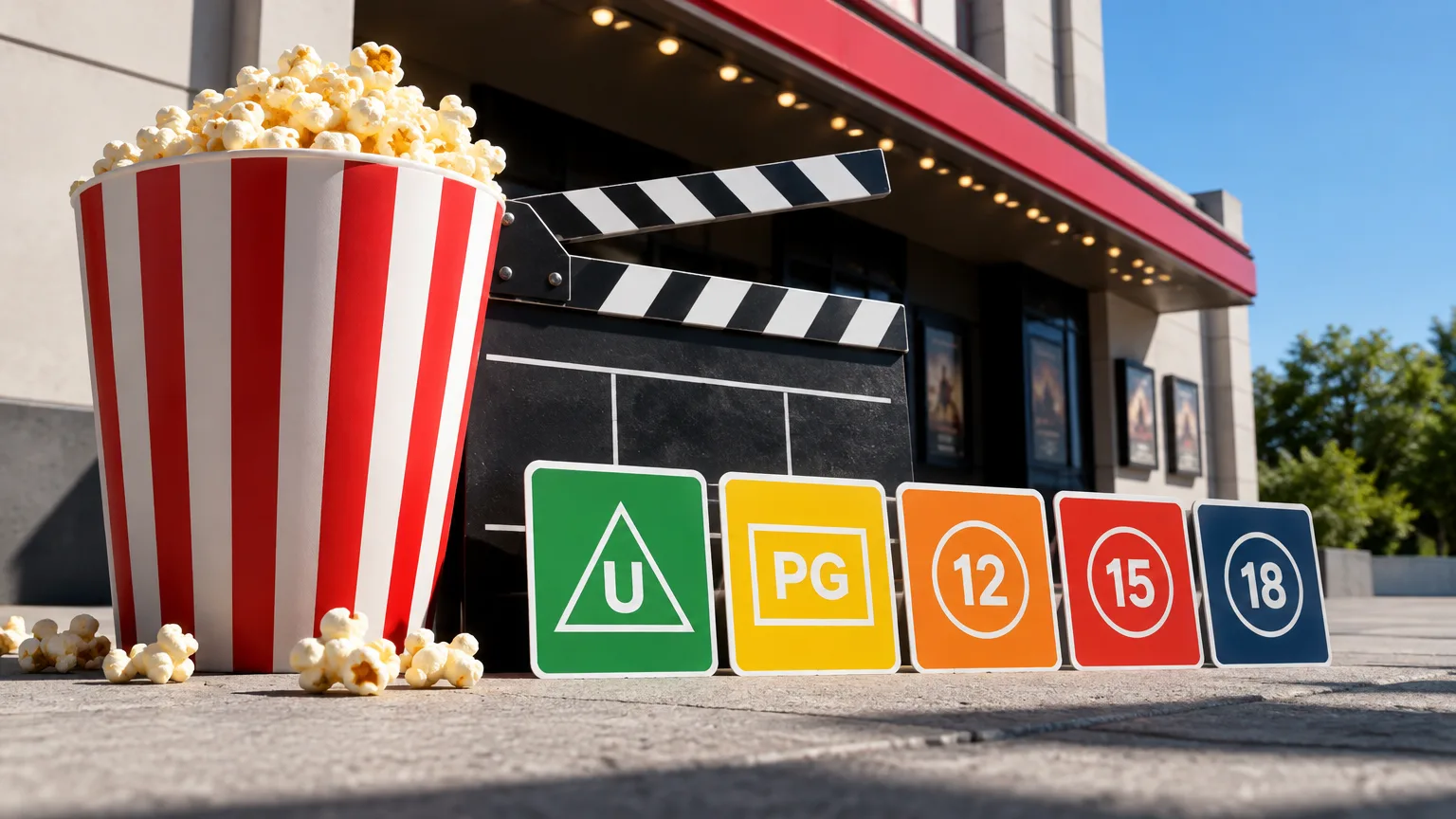
Ratings also change when you cross borders. The British Board of Film Classification, for instance, uses U, PG, 12A or 12, 15, and 18, with its own rules and content advice. A U.S. PG-13 is not a direct translation of a British 12A. For a film listed under another country’s system, read that system’s explanation rather than converting the number in your head.
A practical way to choose a film
Start with the rating, then read the full descriptor. If it names something your child finds especially upsetting—realistic injury, for instance—the broad age label matters less than that detail. A PG film with frightening images can be a worse fit for one child than a PG-13 film with mostly dialogue-driven mature themes.
When the descriptor is too vague, find a detailed parent-oriented review. Common Sense Media’s reviews, for example, break out violence and scariness, language, sex and nudity, and other categories. Its suggested ages are a separate editorial judgment, not replacements for MPA ratings. Reviews may also reveal story details, so skim the content categories first if you want to avoid spoilers.
Then make the choice for the child and the occasion. A teen who wants to discuss a difficult historical drama may be well prepared for material a younger sibling isn’t. A child who enjoys action might still dread a film in which an animal is hurt. If you’re unsure about a home viewing, watching together makes it easier to pause, talk, or turn it off.
Finally, keep suitability separate from quality. A beautifully made R-rated film can be the wrong pick for family movie night; a G-rated film can be dull or confusing. Ratings help answer “What might we encounter?” They leave “Is it good?” and “Is it right for us?” where those questions belong—with the viewers.