A survival game can have gorgeous weather, a clever crafting system, and an entire second continent on its roadmap. If players can only build the same shelter twice before running out of things to do, though, that second continent has no place in the buying recommendation. It isn’t in the game yet.
That’s the central discipline of an early access review: judge the build people can buy, then discuss the planned game separately. The unfinished label changes what kinds of rough edges are reasonable. It doesn’t make those edges invisible, and it doesn’t turn a development plan into playable content.
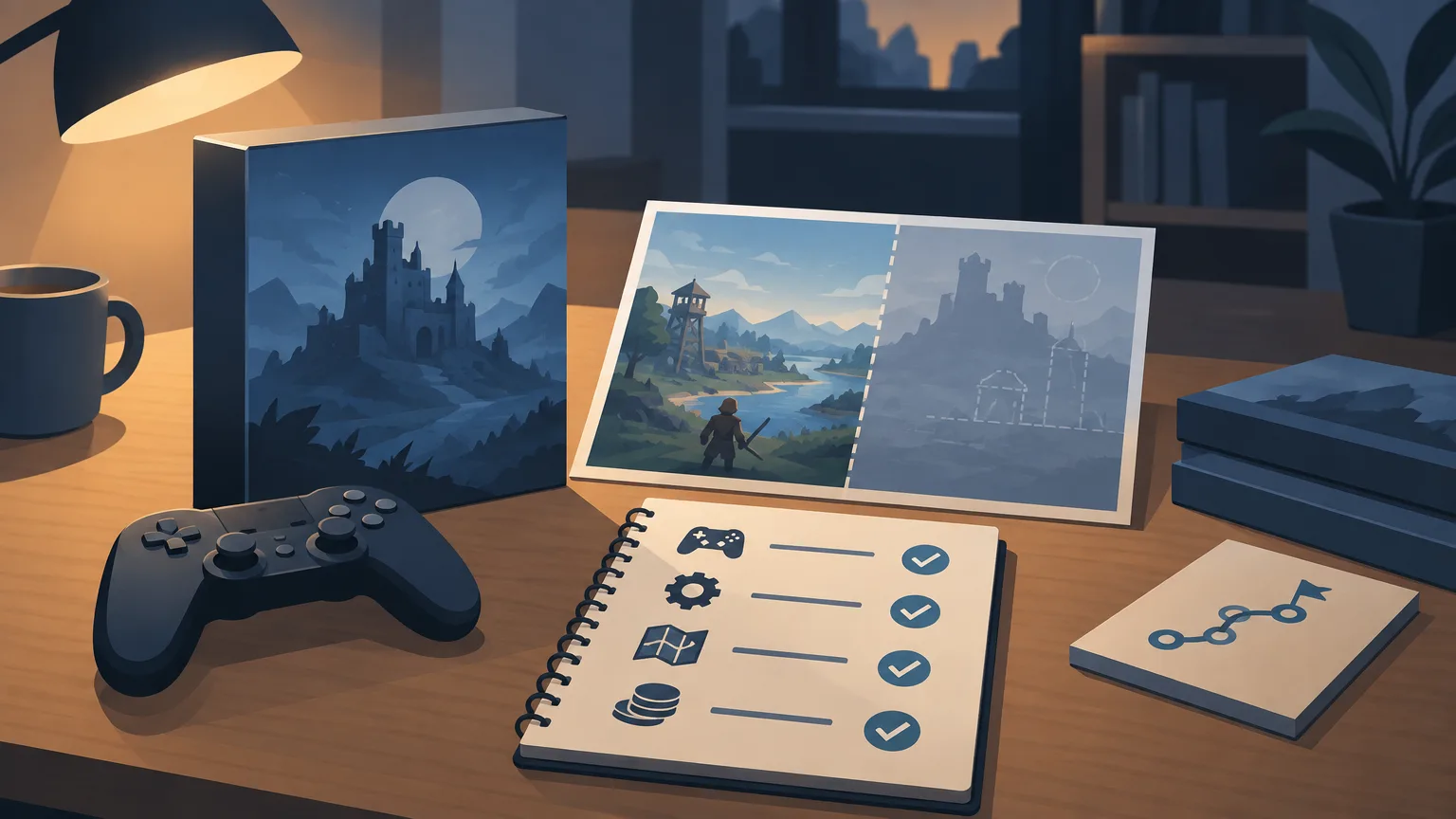
A fair verdict answers two questions plainly: “Is this worth playing at this price?” and “How confident should I be about what comes next?” A game can earn a strong answer to the first and a cautious answer to the second—or the reverse.
Review the build, not the pitch
Before writing about what’s missing, establish exactly what you tested. Record the version number, review dates, platform, relevant hardware, and whether you played solo, with friends, or on public servers. An early access review without that context ages badly: a reader needs to know which build produced the verdict.
Then describe the playable scope in terms that matter to a buyer. “Three biomes” says less than “the first biome supports a full loop of exploration, crafting, and tougher encounters; the other two have little to discover.” For a strategy game, explain which factions and campaign systems work. For a story game, say where the available story stops and whether that stopping point feels deliberate or abrupt.
Steam’s Early Access guidance asks developers to describe what customers can use in the present build, including its modes and features. Reviewers should apply the same standard. A trailer may show the intended scale of a game, but the installed build sets the scope of the review.
The early access label is also worth using precisely. On Steam, Early Access means a playable game still in development; it is distinct from Advance Access, which lets certain pre-purchasers play shortly before release. Calling both “early access” in a review blurs a meaningful difference in what buyers are being offered.
Find out whether the game already has a satisfying loop
The most useful test isn’t “How many hours could someone spend here?” It’s “What makes them want to spend another hour?”
Play past the opening, where tutorials, first unlocks, and novelty do much of the work. In a crafting game, follow the path from gathering resources to building something worthwhile, then see whether the next goal changes your decisions. In a roguelike, check whether repeated runs offer different tactics rather than new item names attached to the same choices. In a co-op game, find out whether playing together adds anything beyond sharing chores.
Content volume still matters, but judge it against the type of experience being sold. A short, replayable tactics game may offer better value than a vast open world filled with interchangeable tasks. On the other hand, a promising combat system cannot carry a campaign if the available missions barely put it to use. Say which kind of shortage you found: limited breadth, weak depth, an abrupt endpoint, or simply not enough variation after the first few hours.
Don’t penalize a game for lacking every feature on its roadmap. Do penalize it when the missing piece prevents the existing game from working. An absent photo mode and an absent matchmaking system have very different effects on an online co-op shooter. Likewise, a sandbox that ends without a final boss may still be absorbing; a story game that stops halfway through its central mystery may be harder to recommend to someone who plays for narrative payoff.
This is where an unfinished game deserves both generosity and scrutiny. You can acknowledge a rough interface as a fixable nuisance while saying that the combat underneath it already feels excellent. You can also admire the art direction while concluding that there isn’t enough game to recommend buying. Neither position requires pretending the build is finished.
Treat stability as part of the experience
“Some bugs” tells a reader almost nothing. Report what happened, how often it happened during your time with the game, and what it cost you. A clipping animation is distracting. A crash that wipes an hour of progress changes whether a session is worth starting.
Test the moments most likely to expose problems: loading a save, quitting and returning, entering a new area, playing a long session, and—where relevant—joining or hosting multiplayer. Note performance settings and hardware rather than treating your frame rate as universal. If a bug appeared once and you couldn’t reproduce it, say that. If every co-op session disconnected, say that too.
An early access build may change while you’re reviewing it. Record the patch version tied to a problem, and retest important faults if a patch arrives before publication. Don’t quietly erase the original experience; explain what improved and what remains uncertain. For persistent online games, check the state of matchmaking and servers at the times you played, since a technically stable client is little comfort if you can’t reliably get into a match.
Some roughness has a longer-term cost. If a developer warns that an update may break saves, make that visible to readers planning a long campaign. Steam’s developer rules call for clear warning when updates are expected to break save files. That is practical buying information, not a minor technical footnote.
Read the roadmap as evidence of priorities, not a list of features you own
A roadmap can tell you what the team understands about its game. It cannot tell you exactly what the finished game will contain.
Look first for a connection between the plan and the problems you observed. If combat lacks useful enemy variety, a near-term update focused on enemy behavior is relevant. A vague promise of “more content” is less helpful. Then compare plans with work already delivered: dated patch notes, changes players can see in the build, and clear explanations when priorities have shifted. Frequent posts alone aren’t proof of progress, and a delay by itself isn’t proof of failure. The question is whether the team communicates concretely and delivers changes that make sense for the game.
Steam explicitly tells Early Access developers not to make specific promises about future events, because planned additions and completion dates may change. A reviewer should be at least as careful. Write “the studio plans to add dedicated servers,” not “dedicated servers are coming,” and don’t raise a score because a trailer shows features that aren’t playable.
Past work is useful evidence, but keep its scope modest. A team that has shipped clear fixes and meaningful updates has earned more confidence than one whose roadmap has no visible follow-through. Neither record guarantees a satisfying 1.0 release. If development has gone quiet, check the dates of both game updates and developer posts before calling a project abandoned. Silence is a warning sign for buyers, not proof of what happened inside a studio.
Ask whether the price makes sense if development stopped here
Value is where future promises most easily distort a review. A low price doesn’t make weak play fun, but it can make a compact, polished build easier to recommend. A high price calls for a stronger experience in hand—not a larger collection of planned features.
Use a blunt thought experiment: if this were the last version released, would you feel good about the purchase? The answer needn’t be identical for every player. Someone eager to experiment with a multiplayer sandbox may get plenty from a rough build; someone waiting for a complete story may get little from its first chapter. Explain that difference instead of forcing one verdict onto both readers.
Don’t assume buying early guarantees a discount. Steam’s pricing guidance notes that developers may set an Early Access price below or above their intended release price. Judge the asking price in front of the buyer, and mention any stated pricing plan only as a plan.
Refunds can reduce purchase risk, but they are a poor substitute for a clear review. Steam applies its refund policy to Early Access purchases, and time played in Early Access counts toward its two-hour playtime limit. Check the seller’s terms before buying—especially if purchasing a key elsewhere—and don’t assume a refund will still be available after spending weeks waiting for updates.
Make the verdict useful without pretending it’s permanent
A review can be decisive about the game today and provisional about its future. In fact, that distinction makes the verdict clearer. State what works, what blocks enjoyment, who is likely to enjoy the available build, and who should wait.
For example: “The combat and character builds make the available missions worth replaying, but frequent co-op disconnects make this hard to recommend to groups. Solo players who enjoy repeating runs have a good game here already; friends buying it chiefly to play together should wait for a stability update.” That gives readers a decision they can act on. “Promising, with plenty of potential” does not.
Be careful with scores. PC Gamer has described using impressions rather than formal scored reviews for Early Access games, partly because an old score can remain influential after the game changes. A score can work if a publication has a clear policy for dating and revisiting it, but the number must rate the tested build—not an imagined finished version. An unscored verdict is often more honest when the biggest question is whether the reader should buy now or return later.
If a substantial update changes the recommendation, revisit the game. Date the new assessment, identify what you retested, and distinguish it from the original verdict. Don’t rewrite history as though launch problems never happened; don’t leave a years-old warning standing without context when a fix has been verified.
Before publishing, a reviewer should be able to answer five things without opening the roadmap: What can I play? What remains enjoyable after the opening hours? What interrupts play? What does it cost? Who should buy this build? The roadmap then adds context about possible change. It should never have to rescue an answer about the game on sale.